Home
Home

Youth Mental Health Day: Are we giving young people enough ways into therapy?

Young people are living with a lot.
This year’s Youth Mental Health Day theme, #BuildFutureYou, asks us to think about how we can help young people move towards a future they can feel hopeful about.
Our Box Therapist Annabel shares her thoughts on the mental health challenges facing young people today and why we need to think differently about how we create opportunities for them to engage with therapeutic support.
The environment matters
This is something I had already started to notice in my previous work in schools. There were young people who appeared resistant to the therapy being offered, and at times the work could feel clunky; as though we were asking them to step out of the rhythms and expectations of school and suddenly engage in a very different kind of conversation with an adult.
Schools are, necessarily, structured environments, with rules about where you sit, how loudly you speak, when you move and how you behave. For some young people, being taken out of class to sit with another adult and talk about their feelings may inadvertently feel like another form of being told off. Even when the therapist is warm and non-judgemental, the context can carry its own meaning.
But our work takes therapy out of the therapy room. The boxing gym has a very different emotional and cultural landscape.
You can turn up scruffy. You can be loud. You can have a bad day. You can be angry. There is a kind of permission in the space to be physically and emotionally expressive without everyone immediately trying to make the feeling disappear. Anger, in particular, can be met with curiosity rather than alarm. It does not have to be hidden in order for the young person to remain welcome.
That does not mean that anything goes. The gym still has boundaries, safety and expectations, and Box Therapy remains a professional therapeutic intervention. But there is a different relationship with emotional intensity. Anger can be understood as information, as an understandable response to what a young person has experienced or to the world they are navigating, rather than simply something that needs to be quietened down.
Alongside the ordinary complexity of growing up, many are navigating uncertainty about the future, pressures around education and relationships, financial strain, social media and a wider sense that the world can be difficult to make sense of. In 2023, 20.3% of 8–16-year-olds in England were identified as having a probable mental disorder, rising from 12.5% in 2017. Among 17–19-year-olds, the figure was 23.3%.
There is an important question alongside these figures. It is not simply whether young people need mental health support, or even whether support exists. It is whether the form that support takes creates a way in for the young person sitting in front of us.
Working within the mental health world, we know that the therapeutic relationship is central to our work. We think carefully about trust, safety, attunement, containment and the conditions that allow someone to explore experiences that may feel difficult or unfamiliar. But perhaps we need to think just as carefully about the environment in which that relationship takes place.
"Movement does not mean avoiding what is difficult; it can create another way of approaching it"
Creating a different therapeutic relationship
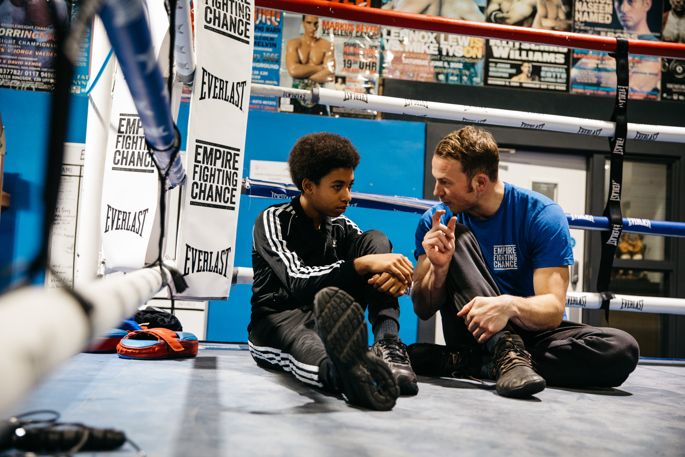
When therapy takes place in a boxing gym, the relationship feels different from the outset. Rather than sitting opposite one another, therapist and the young person are alongside each other, doing something together. We might be moving around the gym, holding pads, practising combinations, walking, talking, laughing or simply figuring out what feels possible that day.
There is something interesting about what happens relationally when two people are engaged in shared physical activity. There is often a degree of natural mirroring: matching pace, rhythm and energy; noticing when the other person speeds up or slows down; learning how much pressure feels right; responding to one another’s movements. Pad work requires attention, reciprocity, trust and communication. These can become another way of experiencing and exploring the therapeutic relationship.
For some young people, this seems to reduce the sense of hierarchy that can exist when an adult therapist sits opposite them in a clinical setting. We are still the professional, and the boundaries remain important, but there is a greater sense of being alongside rather than simply being observed or questioned. The relationship becomes something experienced through doing as well as talking.
A moving therapeutic container
For me, one of the most useful ways of understanding this is to think of the boxing gym as a moving therapeutic container. A traditional therapy room provides a stable physical container in which difficult experiences can be brought and held. The gym can provide containment too, but it is less static. A young person might move, pause, change activity, work through something physically, regulate their breathing, have a laugh and then return to a difficult conversation. Movement does not mean avoiding what is difficult; it can create another way of approaching it.
Making space for joy
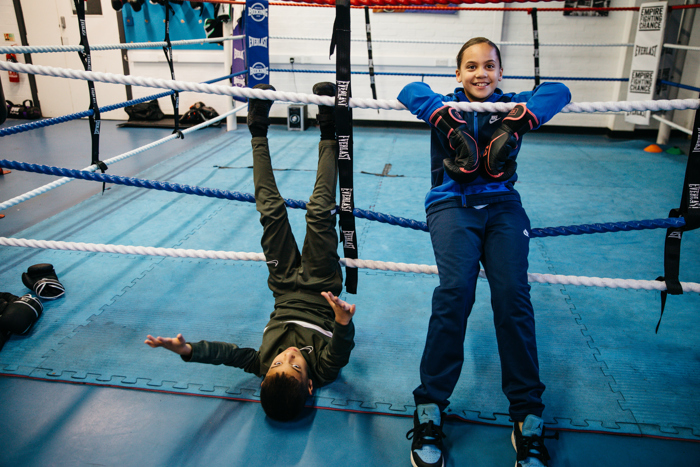
It has also made me think differently about joy. Therapy does not become less therapeutic because a young person is laughing. A young person can be carrying something difficult while also enjoying themselves, feeling competent, building relationships and discovering that an adult can be alongside them in something that is fun. For young people who have become disconnected or withdrawn, moments of curiosity, enjoyment and wanting to come back can matter.
Different routes into therapy
This is not an argument that boxing is the answer, or that traditional talking therapy is inadequate. The evidence for non-contact boxing as a mental health intervention is promising but still developing. The more interesting question is what we learn when we change the conditions in which therapy happens. If our goal is to make therapeutic support accessible to more young people, perhaps we need to become more curious about the different routes into a therapeutic relationship. What happens when we move from sitting opposite someone to being alongside them? What becomes possible when the body, environment and shared activity become part of the work?
Box Therapy grew from that curiosity. It combines psychotherapy with non-contact boxing, using boxing as the medium and environment through which therapeutic work can take place.
Youth Mental Health Day is a useful opportunity to ask ourselves not only whether young people have access to therapy, but whether they have enough different ways into it. There may be young people we are trying very hard to engage who do not need less therapy. They may need us to think differently about how we offer it.
That is what Box Therapy is ultimately about: not replacing the therapeutic approaches we already have, but widening the doorway into them. For practitioners, that means being curious about environment, movement and relationship — and being willing to develop the skills to use those things safely and ethically.
Could Box Therapy work in your setting?
The next Box Therapy Training takes place on 28–29 October 2026 at Croydon Boxing Club. It is designed for qualified therapists and trained mental health practitioners and includes two days of practical and therapeutic training, plus one year’s access to the Box Therapy Community of Practice. The cost is £200.
If you are a therapist or mental health practitioner working with young people and are interested in exploring a different way of engaging those who may not connect with traditional approaches, we would love to hear from you. To find out more, including more details of what the course will cover, visit our dedicated Box Therapy training page.